GaramChai.com,
Indian Yellow Pages in the US. Online Marketing to the Indian American
community |
Pravasi Bharatiya Divas (PBD) is celebrated on
9 January every year to mark the contribution of Overseas Indian community in
the development of India. January 9 was chosen as the day to celebrate this
occasion since it was on this day in 1915 that Mahatma Gandhi, the greatest
Pravasi, returned to India from South Africa, led India's freedom struggle
and changed the lives of Indians forever.

Also check out question: What is it like giving up Indian
citizenship?
With over 60 percent of Indian Americans holding a
college degree and the majority in the workforce, marketers are starting to
drool over the potential of this ethnic segment. We aim to provide everything
Indians living in the United States
may need to maintain their lifestyle outside of India. This site
is a complete resource listing of 400 temples, 500 restaurants,
500 bazaars and online shops. Other listings include jewelers, wedding
specialists, theaters, beauty salons, Mosques and Gurudwaras. To
view a complete index of our offerings tailored to the needs of
Asians, Indians, NRIs Pakistanis,
Sri Lankan and other South Asians and
others in the US, Canada and North America. A number of business and media streams are already successful in
targeting this market segment:
- India Bazaars,
boutiques and grocery shops: Hundreds
of shops in all the major cities in the US cater to this market. A few large
wholesalers successfully manage a complex supply chain of ethnic groceries,
vegetables and commodities ranging from Coconut oil to cumin
seeds.
- Indian Restaurants:
Most major cities can boast of at
least a few Indian restaurants. Even though Indian restaurants in the US are
not as ubiquitous as they are in the UK where every street corner has one,
they are in sufficient numbers to cater to local palate.
- Hindu Temples, Mosques, Churches, Gurudwaras, Jain Temples and cultural centers:
Over the years, several temples,
gurudwaras, Indian churches and cultural centers across the country have
sprung up, catering to the religious and social needs of the ethnic
communities. Interestingly, even in places with smaller populations of
Indians, informal bhajan groups and congregations provide a sense of ?
community.?
- Indian newspapers, magazines
and publications: A number of
Indian newspapers and magazines are successfully published and circulated in
the US.
- Electronic media:
Saying that Indians in the US have
taken to the web like ducks to water would be an understatement. A number of
Web-portals, e-mailing lists, and groups already provide extensive coverage
to this segment.
- Entertainment industry:
Cable channels and movie screeners
provide extensive choices to this target audience. Bollywood also drools over
the size of the American distribution segment as a major source of
revenue.
- NRI
Services: Details on Services for
Non Resident Indians
|
Special Feature:
Indian Government's decision to do away with 500, 1000 RUPEE NOTES! Impact
on NRIs |
Impact of Indian Government's decision
to de-monitize 500 and 100 Rupee notes.
In a much applauded move Prime Minister
Narendra Modi's government decided to "kill" the 500 and 1000 rupee
notes. Some of the notes in circulation were supposedly fake and some of it
used to fuel the underground economy (a.k.a "black money"
)
"Brothers and sisters, to rid this country of the termite-like
corruption and black money, it has become essential to take one more tough
step. Starting midnight tonight, that is, on the midnight of November 8,
2016, the current currency notes of denominations of rupees 500 and rupees
1,000, will no longer remain legal tender. These currencies will become
legally invalid."
Read rest of the special feature,
including impact on NRIs in our special section (link)
In a much applauded move Prime Minister Narendra Modi's government
decided to "kill" the 500 and 1000 rupee notes. Some of the notes
in circulation were supposedly fake and some of it used to fuel the
underground economy (a.k.a "black money" )
"Brothers and sisters, to rid this country of the termite-like
corruption and black money, it has become essential to take one more tough
step. Starting midnight tonight, that is, on the midnight of November 8,
2016, the current currency notes of denominations of rupees 500 and rupees
1,000, will no longer remain legal tender. These currencies will become
legally invalid." - Link to official announcement
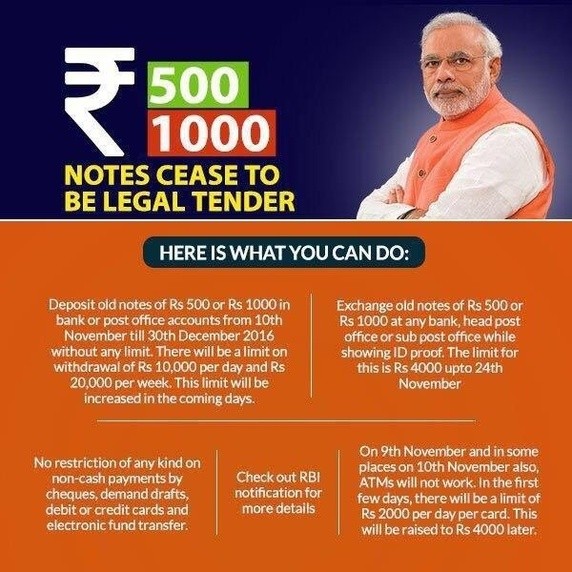
Bloggers and digirati have eagerly jumped on this issue and have
been circulating viewpoints:
NRIs and visitors to India probably have some 500 and 1000 rupee
notes left over from previous trips are probably wondering what to do with
the notes. Key facts and practical tips are featured on the special section "FAQ on 500 rupee for
NRIs" on GaramChai.com (link) |
In the News: The
Patanjali Aurved Phinomena |
| The Patanjali Aurved Phinomena is rocking Indian
Fast Moving Consumer Goods (FMCG) sector. The Non Resident Indian community
is also going ga-ga over Patanjali products. Here is a feature including
links to latest articles on the topic.

Power Yogi: How Baba Ramdev became
India's swadeshi FMCG baron (India Today, July 2016):
"The sun is about to set behind the forests on the outskirts of Haridwar. The
downpour of the previous night has made it a relatively pleasant summer
evening. The silence in one of India's most guarded ashrams - CRPF personnel
frisk you every time you enter the premises - is punctuated by the sound of a
fountain in the middle of the manicured lawn, and of a swing in the verandah
of an M-shaped cottage. In the saffron hues of dusk, a saffron-clad yogi is
sitting on the swing. His eyes are closed, as if meditating to find the
answer to the simplest, most obvious, and somehow the trickiest question
posed to him: why is a self-proclaimed renunciate selling shampoo,
toothpaste, detergent and anti-ageing cream?
When he opens his eyes, the lopsided smile and the mischievous glint in the
eyes are gone. "When I went to the Himalayas in my youth, I saw many sadhus
who had given up the materialistic life. But what were they doing? Nothing
for the welfare of mankind. That cannot be the purpose of life. In India,
it's believed that sadhus can't do anything; they are supposed to live on
donations. It hurt me. The real goal of a sadhu is not to attain moksha for
himself but to serve the masses. My business is not for profit but to spread
wellness," says Baba Ramdev, 48, India's most celebrated yoga guru, who is
riding high on a heady, hitherto untasted cocktail of yoga, satsang,
ayurveda, business and politics.
Ramdev stands out from all other gurus on the Indian social spectrum not just
because of the size of his burgeoning FMCG empire - worth Rs 5,000 crore at
last count - but also because he wears his political inclinations on his
sleeve. He purportedly has a direct line to Prime Minister Narendra Modi, and
is close to several members of the Cabinet and a number of chief ministers
across the land. He was one of the key figures of the Lokpal movement in
2011, was received at the airport by then finance minister Pranab Mukherjee
as the UPA government tried to broker a deal with its leader Anna Hazare, and
cut a comical figure when he was taken into custody at the Ramlila grounds in
Delhi while trying to escape dressed in a salwar kameez. He is an advocate of
replacing the tax system with a single transaction tax. He kickstarted the
black money drive that became one of the key campaign promises of the BJP in
the 2014 Lok Sabha elections. And he now stands as a major support booster
for the Modi-led NDA government. When he isn't slamming those who returned
government awards in protest of alleged intolerance, he is threatening to
chop off the head of anyone who refuses to chant 'Bharat mata ki jai'. From
drug abuse in Punjab to the spiritual health of the relationship between a
husband and wife, and from the purported horrors of homosexuality (which he
can help "cure") to the importance of buying desi, the guru's discourses
encompass a vast universe."
Link
to GaramChai.com special feature on Patanjali
Link to Patanjali Android App
|
Book Review:
The Bounce!: A Story of Love, Loss and the Life of a Global Indian
|
|
|
India Empire: Bouncing back!
Mohan, an IT professional from North Carolina has strong roots to India. He
has moved and lived across three continents in five countries and visited
dozens others. In a candid interview with India Empire's Assitant Editor,
Misha Singh, Mohan talked about his journey, experiences and his debut book
"The Bounce! -- A Story of love, loss and the life of a global
Indian"
This is your first book. What inspired you to write the book?
I have written and blogged extensively on technology and management topics,
but this is my first fictional book. I had been reflecting on an incident,
back in 2008 when we lost a healthy, bouncy child while on a Jet Airways
flight from Brussels to Delhi. My wife and I were relocating back from
Toronto with a five and half month old child when tragedy struck. The book is
an attempt at redemption, especially as writing has been very cathartic for
me.
By talking about my story, I am also hoping to provide some inspiration to
others facing life's challenges on bouncing back, as the title suggests.
This is a semi-autobiographical novel, what can the readers expect from the
same?
Much of the story depicted in the novel is mine. I decided to write a semi-
autobiographical novel since this format gave me a bit of artistic liberty to
stretch my imagination while basing the outline on facts as I remembered
them. A few accounts, and names have been fictionalized and I rely on the
dialog style that a fiction can accommodate more than a biography.
What was your goal when you wrote the book--was it to just finish writing or
getting it published and reaching out to the world?
My goal in writing "The Bounce!" was simple. I had a story that I thought
must be told. It is also an attempt to show a human face to globalization and
people in the dynamic global outsourcing industry who travel around the
world.
How did you begin writing this book? What do you wish to convey with the
book?
I began writing the book in 2012. After attempting to write it as a
biography, I switched to a semi-autobiographical format earlier in 2015.
There are a couple of key messages I feel I am conveying in the book. My
journey is an example of living this adage, and wanted to share my life's
journey and the dynamic nature of outsourcing industry with readers. The key
message is about redemption. The theme of "The Bounce!" is all about the
ability to bounce back, especially after unforeseen tragedies in
life.
What authors do you like to read? Do any of them influence your writing?
I firmly believe in the adage "he, who reads more, writes more". My reading
habits are eclectic and include fiction and nonfiction books on business and
technology.
'Elizabeth Gilbert's cheerful narrative "Eat, Pray, Love" highlighting how
she overcame her life's challenge was an inspiration at the time in life when
I needed one.
Please tell us something about you and your connect with India?
I grew up moving across India. After completing my masters from an
Engineering college in Mysore, I joined a British software firm in Bengaluru.
I worked with Infosys for nearly a decade and now live the Indian-American
dream in North Carolina with my charming wife Sujatha and adorable
kindergartener Vijay. My parents live in Bengaluru and my in-laws in Delhi
and I try and make an annual trek back there with my family. The intent is
also to ensure Vijay bonds with his grandparents and cousins while retaining
his Indian-ness.
A great fictional debut by a Non-Resident-Indian author (Review by -
India Empire |
About the Author Mohan is an Indian
American Information Technology executive with a multinational company
headquartered in Switzerland. He has lived and worked in five countries
across three continents, gaining a first-hand experience of working in
multicultural environments.
Mohan is also a blogger, columnist and writer whose viewpoints and papers
have been published in several international technical and non-technical
journals. He lives in North Carolina with his lovely wife and adorable
kindergartener.
Link to
read rest of the blog // Book on Amazon.com |
|
Search
|
|
Search
GaramChai.com and other information
|
Though
websites like Sulekha, Search India and others attract
advertisers
by providing listings, events, chat and discussions,
Garamchai.com
aims to be the most extensive information directory with
a
simple but elegant user interface. GaramChai.com is a
complete
resource listing of hundreds of temples, restaurants
online
shops, grocers and bazaars. Other listings include
jewelers,
wedding specialists, theaters, beauty salons, mehndi
services,
places of worship including Temples, Mosques, Churches
and
Gurudwaras. With the large amounts of information, the
site
is well organized dividing most listings into state
categories.
Sending comments or suggestions is simple with a form
that
is provided on the site or by emailing us [Replace _at_
with
@] This
section of GaramChai.com will attempt to address some of
the
Frequently Asked Questions on Life in the US and Canada
that
immigrants, visitors and others from different cultures
attempt
to address.
|
|
|
Advert Partner
|
|
|
|
Advert Partner
|
|
|
Advert
Partner
|
|
|
|
Insurance
Channel
|
|
|
|
Google
Advert
|
|
|
|



